
I often see people asking about what they need to prepare for their RPG or DnD session, and though what needs to be prepared depends on the system and the group, here are 3 tips to help you prepare for narrative play in any of your games.
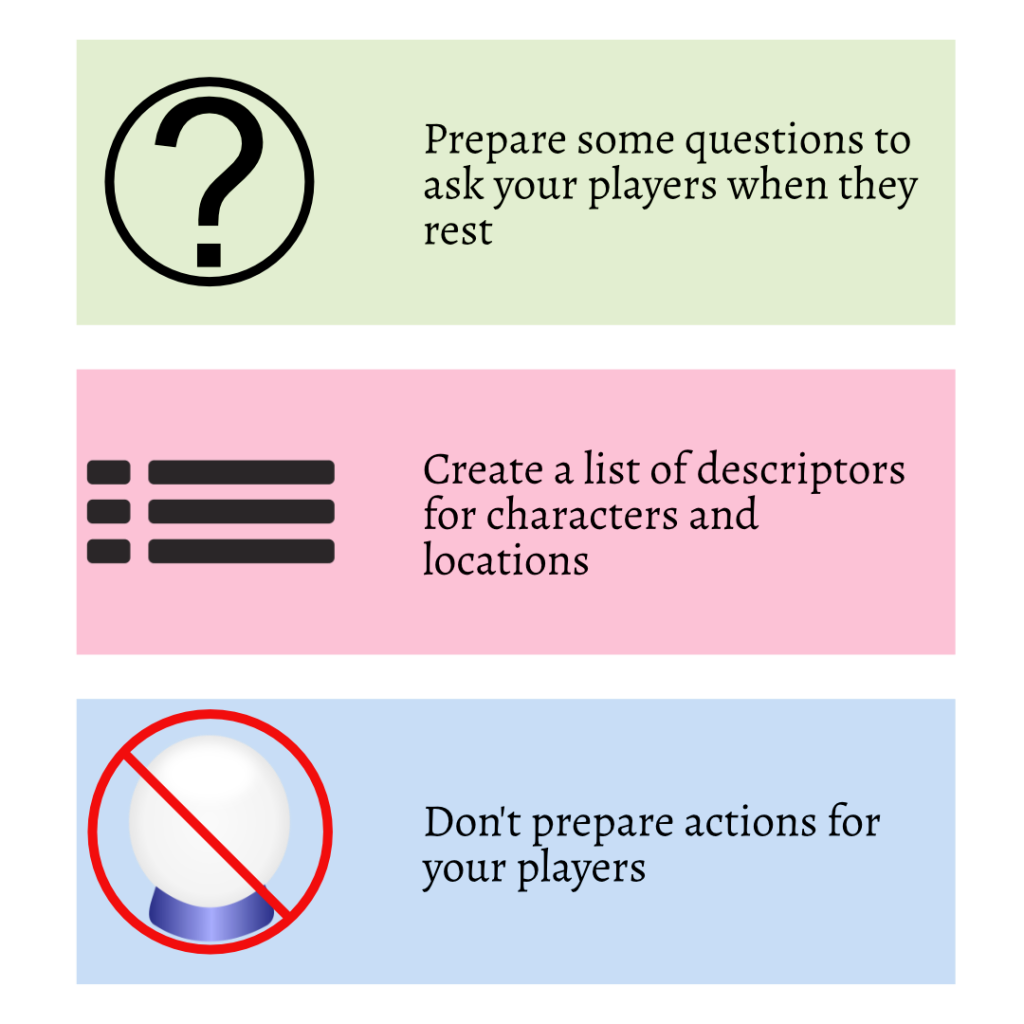
Create some questions to ask your players when they rest
The absolute fundamentals of RPGs like DnD is asking questions, so you should create some ahead of time to ask your players during the game.
I use questions profusely in all elements of my RPGs, even the games I design myself. Questions can be used in RPGs to:
But here is a quick way to apply questions in a meaningful way in your games of DnD: Create 1-2 questions per player when you prepare for your DnD games.
Whenever you sense a lull in the action or want to create space in the narrative for your players to immerse themselves, ask them one of your prepared questions.
An ideal time for this is when your characters rest in your DnD games because often just a bit of book keeping is happening, so by asking these questions you bring in more narrative play.
These questions can be about whatever you like, though here are some topics that I find to always be impactful:
- An event that occurred during the game such as the action of an NPC or PC.
- A rumour the players have heard or a clue that they may have forgotten about.
- An element of a character’s backstory.
You will have noticed that these topics tend to also remind the players of what is happening in the campaign. If you’re going to be asking questions, try to always tie it back to what is going on around the characters and keep the questions open-ended to allow the player more agency in their answer.
Here are some examples of questions you might ask:
- “Anya, Troy’s character, Brimdash, made a mockery of the group when you were all striking a deal with your patron. How does your character, Grio, feel about that?”
- “Troy, Brimdash did find a strange piece of fabric back in the cave. How do you think it might relate to what the city guard is talking about?”
- “After setting up camp for the night, Grio takes first watch. Anya, looking over your sleeping comrade’s forms reminds Grio of what happened all those years ago. How do they react to this thought?”
Create a list of short descriptors for your characters and locations
Describing a scene in your DnD games helps your players (and yourself) become more immersed in the narrative. Some people just list what is in the scene while others speak the purplest of prose. I like functional descriptions with just a sprinkling of adjectives for my characters and locations.
It can be hard to improvise flowery descriptions to engage your players when you have to juggle so many other thoughts. Sometimes it can be harmful to this engagement too because some players might not be familiar with the words or they might become lost in the words.
This is why I recommend more functional descriptions. A happy middle ground between listing what is there and the purple prose.
To do this, create a list of 3-5 descriptors for each character or location in your DnD game. Each descriptor should just include an adjective or a verb, and a noun, but be sure to avoid boring descriptors like “purple coat”.
Here are some examples:
- Deceitful eyes.
- Wet smirk.
- Tobacco-scented clothing.
The idea behind this is to inspire you when you improvise a description, let your mind wander when you read these descriptors.
When you go to describe the character or location, pick 1 or 2 of the descriptors in your list and use them to inspire the scene. Then, as the scene continues, call back to those elements you described or introduce a new one.
Using the previous descriptor examples, a scene might begin like this:
GM: “Trish, the gambler from the other night, studies the crowd closely, then takes a drag on her cigarette. Her eyes meet yours and she beckons you over with a curt nod. What do you do?”
Player: “I walk over, picking up someone else’s drink in the process and taking a seat next to her.”
GM: “Trish exhales a cloud of smoke which wafts over your face. She smiles which sends the saliva pooling at the corners of her mouth down to her chin. Fancy seeing you here tonight. Her voice is wet. How do you respond?”
You will have noticed much of the descriptions also tend to describe actions and always ends with a prompt for the players. When you describe a character or a location, use your prepared descriptors and always lead your players into the scene with prompts.
Don’t prepare actions for your players
A roleplaying game is all about the collaborative telling of a story which involves all of the players (and the GM) adding their own ideas to the narrative. Sometimes the system or other players subvert these ideas, thus emergent narratives are born!
This is what you want, so don’t prepare any actions for your players because it undermines the emergent narrative.
Whenever you are preparing your session, read over what you wrote and if you find that you have written something like “the players will” or “when the players will” either remove it or replace it with “if the players”.
This is a subtle change to your notes and the idea behind this is to help you stay focused on what the players are doing in the game, rather than what you are expecting them to do.
You should be surprised in your games. If it means you need to take a minute to think, that’s okay! Ask the players a question while you do it.
Closing thoughts
I routinely employ all 3 of these tips to some degree. I might not always prepare 1-2 questions per player, but that’s because I have reached a level of comfort with improvising these kind of questions, but I always ask them. There are so many characters and locations in my games, I find it essential to have these lists prepared ahead of time.
Is there something you do in your preparation that helps you bring more narrative play into your games? Comment it below!



 The Bardic Inquiry
Leave a comment